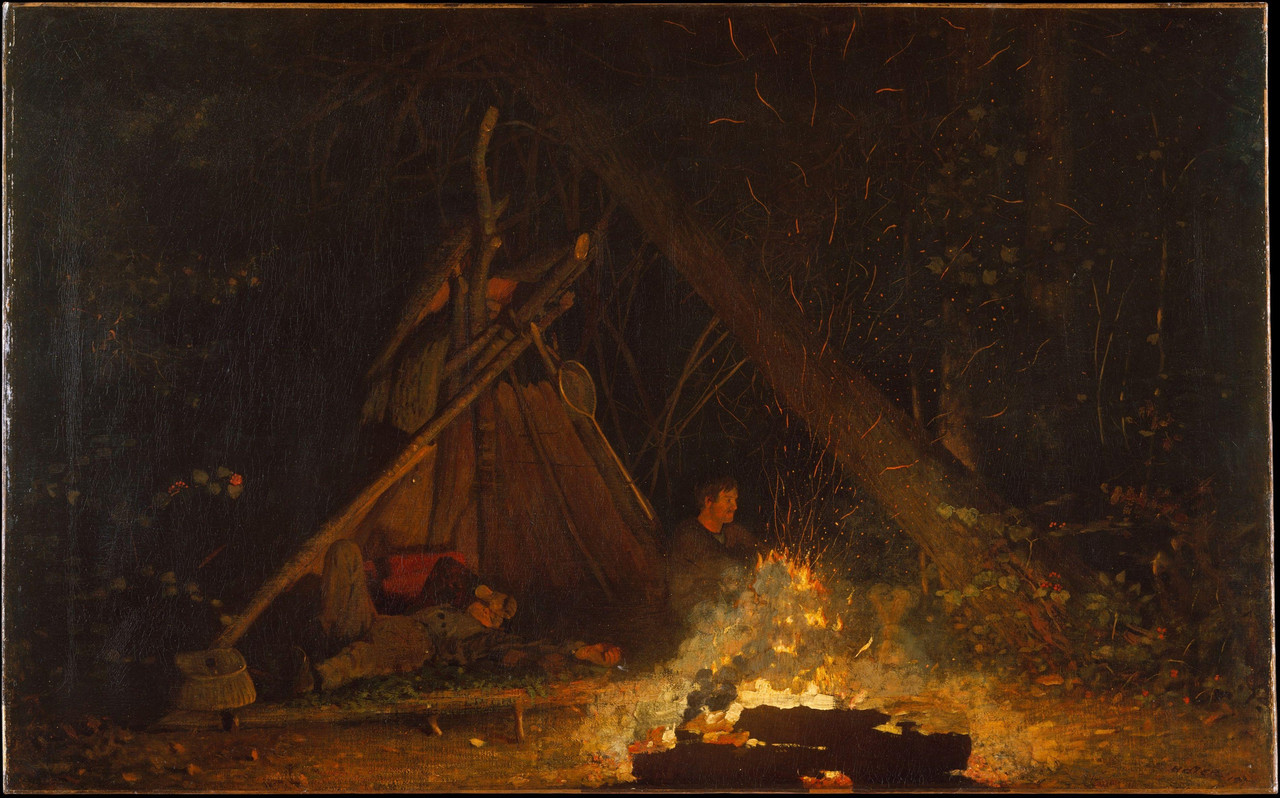
 Winslow Homer, Camp Fire. Oil on canvas, 1880
“History repeats itself” is one of those phrases that became so overused it lost its meaning, so whenever I hear it, read it, or see it on a sticker or a T-shirt, it irks me. Some variations of the phrase exist as well, such as “Those who forget history are condemned to repeat it.” I personally like Mark Twain’s “history does not repeat itself, but it does rhyme” because History does not repeat itself. At a surface level, one might say that the financial crisis of 2008 is the same as that of 1929, or that the German offensive on the Soviet Union in 1941 is the same as the French invasion of Russia in 1812. The one comparison that’s gaining popularity Today is the cyclical dynamic of the rise and stagnation of the Roman Republic and the United States of America. I won’t doubt that I don’t see the resemblance in these events; the difference in context, causes, and results still, however, stands. But maybe the thing that bother me the most with this expression is that it represents the relationship I notice people have with History, this prophetic thing that is doomed to repeat itself regardless of what we do or won’t do, a lack of understanding of the context and the nuance that it brings with it, and most importantly as this medium of enjoyment and bragging that is oftenly used in nationalistic circles, but that we are all guilty of doing from time to time. Which brings me to this question: why do we learn History?
It all began with two of the most important inventions in the history of our species: fire and stew. You see, fire was, at the time, what the Twitter bots claim an AI Chatbot is: a revolutionary discovery. It gave our ancestors a weapon, something to keep us warm in winter and light to see at night. Stew gave us access to more nutrients and less bacteria and toxins in our food, and it made our brains grow bigger; less energy spent digesting means more for thinking (in the business, we call this foreshadowing). The best contribution it made was to reunite family members or a tribe. Our early ancestors used to sit around bonfires and eat stew together, and that had a lot of impacts in itself, but I want to focus on two. Firstly, it built rapport, trust, and social cohesion among the group's members, making hunting, governing, and simply living together more efficient. It gave us the evolutionary advantage that enabled our species, not the other hominids, to dominate this planet through collaboration. The second thing it did was make the intergenerational knowledge transfer possible.
The survival benefits of learning from others' experiences cannot be overstated. A young animal venturing into the world faces countless dangers, from poisonous plants to hidden predators. Instead, in each generation, our ancestors learnt which foods to avoid, where water can be found during drought, and how to recognize the signs of approaching danger. This dramatically reduced the mortality costs of learning and allowed populations to thrive in environments that would otherwise exact a terrible toll on each new generation. Cultural knowledge has also enabled a level of specialization and social complexity that would be impossible through genetic evolution alone. In human societies, individuals can dedicate their lives to mastering specific crafts, sciences, or arts, passing their expertise to apprentices who will refine and extend it further. This division of cognitive labor has allowed us to develop technologies and social structures of breathtaking sophistication, from the construction of cathedrals to the mathematics of quantum mechanics. No single person could hope to master all human knowledge, but through cultural transmission, the collective wisdom of our species becomes accessible to each member of our species.
Finally, transgenerational knowledge transfer has allowed humans to expand into virtually every terrestrial environment on the planet without requiring genetic adaptations to each one. The techniques for surviving in the Arctic are radically different from those needed in the Sahara. Yet, humans thrive in both because they inherit culturally transmitted strategies specific to each habitat.
As Human gatherings grew more populous and complex, moving from small agricultural gatherings to big settlements and cities, and as we evolved from a species of tribes to one of civilizations, so did transgenerational knowledge transfer, laying the foundation for what we now refer to as history. First, orally; then, in writing, as multiple systems emerged from China to Mesopotamia to Mesoamerica, for the sole goal of transferring information to the next generation. The invention of writing marked a fundamental shift in how cultural knowledge could accumulate, no longer constrained by the limits of human memory or the fragility of oral tradition. The transition to complex societies brought with it new forms of knowledge that demanded preservation: legal codes, religious texts, administrative records, astronomical observations, and accounts of significant events. Mesopotamian scribes recorded the reigns of kings on clay tablets, Chinese historians compiled detailed dynastic chronicles, and Greek writers like Herodotus attempted to explain the causes and consequences of significant conflicts. Philosophy flourished, and art became widespread. Libraries were erected and Wonders spawned across the continents, most of the time taking years or decades to be built, by multiple generations.
When I go online and see people viewing history through the lens of old battles and who triumphed over whom, picking sides and cheering through web events that happened a long time ago, as if it’s a football game, I feel a bit sad. I feel sad when I hear the same people questioning the reason why we learn history in school in the first place, as opposed to something “more useful” , such as English or Maths, subjects that have monetary gains in our careers. And being a STEM graduate myself, I encountered this sentiment more times than I can count throughout my university years, sometimes extended to include arts, literature, and social studies. The irony is that many mathematicians, chemists, and physicists were also artists. Leonardo da Vinci moved fluidly between painting the Mona Lisa and designing flying machines, seeing no contradiction between artistic vision and mathematical precision. René Descartes and Bertrand Russel revolutionized both Philosophy and mathematics. Plank, Heisenberg, and Schrodinger all played Piano, Cello, and violin, respectively. Carl Friedrich Gauss made groundbreaking contributions to number theory while also delving into poetry, linguistics, and literature. Michael Faraday, also known as the father of electricity, was also a skilled illustrator, and his scientific diagrams were as precise as artistic. These figures would have found our modern insistence on separating disciplines into "useful" technical subjects and "impractical" humanities utterly nonsensical. The question of what constitutes "usefulness" deserves closer examination. When we claim that mathematics and English are more useful than history because they lead to better career prospects, we're making a particular judgment on what education is for. We're suggesting that the primary, perhaps the only, purpose of school learning is to maximize our earning potential. In other words, making ourselves more valuable commodities in the labor market, a more important cog in the machine. But this is itself a historical perspective, one that would have seemed strange to most societies throughout human history and even to many educators in the relatively recent past.
Consider what we actually lose when we view education purely through this economic lens. History teaches us that our political systems, financial structures, and social norms aren't natural laws; they're human inventions that could have turned out differently. Ideas we now accept as obvious were once unthinkable, and beliefs that entire civilizations held with absolute certainty turned out to be catastrophically wrong. This knowledge is essential for citizens making decisions about how to organize society or respond to crises. If STEM is the how, then the humanities are the ability to ask why. Engineering can build surveillance systems, but it takes historical thinking to ask whether we should make them and whose interests they serve. Computer science can create algorithms that maximize social media engagement, but understanding how propaganda works and how mass movements get manipulated requires studying history. Biology can edit human genes, but deciding which traits to select and who makes those decisions demands engagement with history and ethics.
When someone dismisses history as useless while championing mathematics or coding as practical, they're ironically demonstrating historical ignorance of their own race. The human mind yearns for art, debates, music, and knowledge; it yearns to satisfy this urge of curiosity that is enshrined in our basic code. The same curiosity that made us discover fire and cross oceans is the same that wants to understand the Golden ratio, where we came from, what our purpose is, and what it means to be good. Just like our minds grew when we had more literal energy to feed our minds, our collective one grew infinitely more when we had more energy not killing each other. Philosophy emerged in Greece during peacetime, Al-Andalus flourished in peacetime, and the Roaring Twenties followed the end of the Great War.
The tragedy of viewing history and the humanities as impractical luxuries is that it produces technically skilled people who lack the intellectual framework to understand the broader implications of their work or to participate meaningfully in democratic deliberation. We end up with engineers who can build powerful technologies but who haven't thought deeply about their social consequences. We end up with data scientists who can optimize systems without considering whose interests those optimizations serve. We end up with citizens who can navigate complex professional tasks but who are easily manipulated by propaganda because they lack a historical perspective on how mass movements and information warfare have functioned in the past. We end up with totalitarianism and fascism. We end up with a thirst for needless jingoism, and we shoot ourselves in the foot.
The best scientists have often been those with broad cultural knowledge and humanistic sensibilities. The most insightful historians have frequently been those who understood statistics, economics, and scientific methods. And the people best equipped to navigate our complex, rapidly changing world are those who can move fluidly between different ways of knowing, who understand both how things work and why they matter, who can combine technical competence with historical consciousness and ethical reasoning.
In Morocco, we eat Mrouzia during celebrations and holidays. We still follow the same recipe that emerged in Al-Andalus in the 13th century. Maybe Mrouzia isn’t a stew in itself. Still, by continuing that tradition, we are sharing it with our ancestors, gathering around, making our favourite dish for our favourite people, and that’s what learning history is at its core, sharing a metaphoric stew that knows no bounds of time.